At the annual Chaos communication congress, in this specific case the 39C3 a talk was given by Hajo Noerenberg and Severin von Wnuck-Lipinski called hacking wasching machines .
In this talk Hajo showed how he made wasching machines among other home appliances manufactured by B/S/H smart, or to be more precise, integrate them into Home-Assistant .
It was the best talk I have seen in a long time and as an owner of at least two BSH appliances (washing machine and a dryer) I was immediately on fire to get this into my machines as well. At the end of the talk Hajo said he could use help designing and manufacturing a custom PCB for this, as he only had a dev board setup.
I reached out and offered my help, which resulted in the BSH-Board .
But before I could start sending them out to other enthusiasts, I needed an invoicing solution, preferably self-hosted and free as I didn’t plan on making money on these boards.
After a search I stumbled over Invio , a brand new invoicing solution with just the basics, no clutter. Perfect 😎
A few years ago I already sold PCBs. Small 1-wire boards that can act as simple sensor interfaces and be read out from the Loxone 1-wire extension .
Back then I wrote my own invoicing solution, but I couldn’t find what I botched together back then. The only thing I remembered as extremely helpful was the purchase of Deutsche Post Internetmarken (a digital postage stamp) directly out of the UI and the direct printing via a Brother QL-710W .
I asked kittendevv if he can integrate such a functionality directly into Invio. He said maybe in the future, but as I had BSH-Boards on their way, I had no time to waste and decided to build my own sidecar solution as a Invio extension.
Out of this came franking
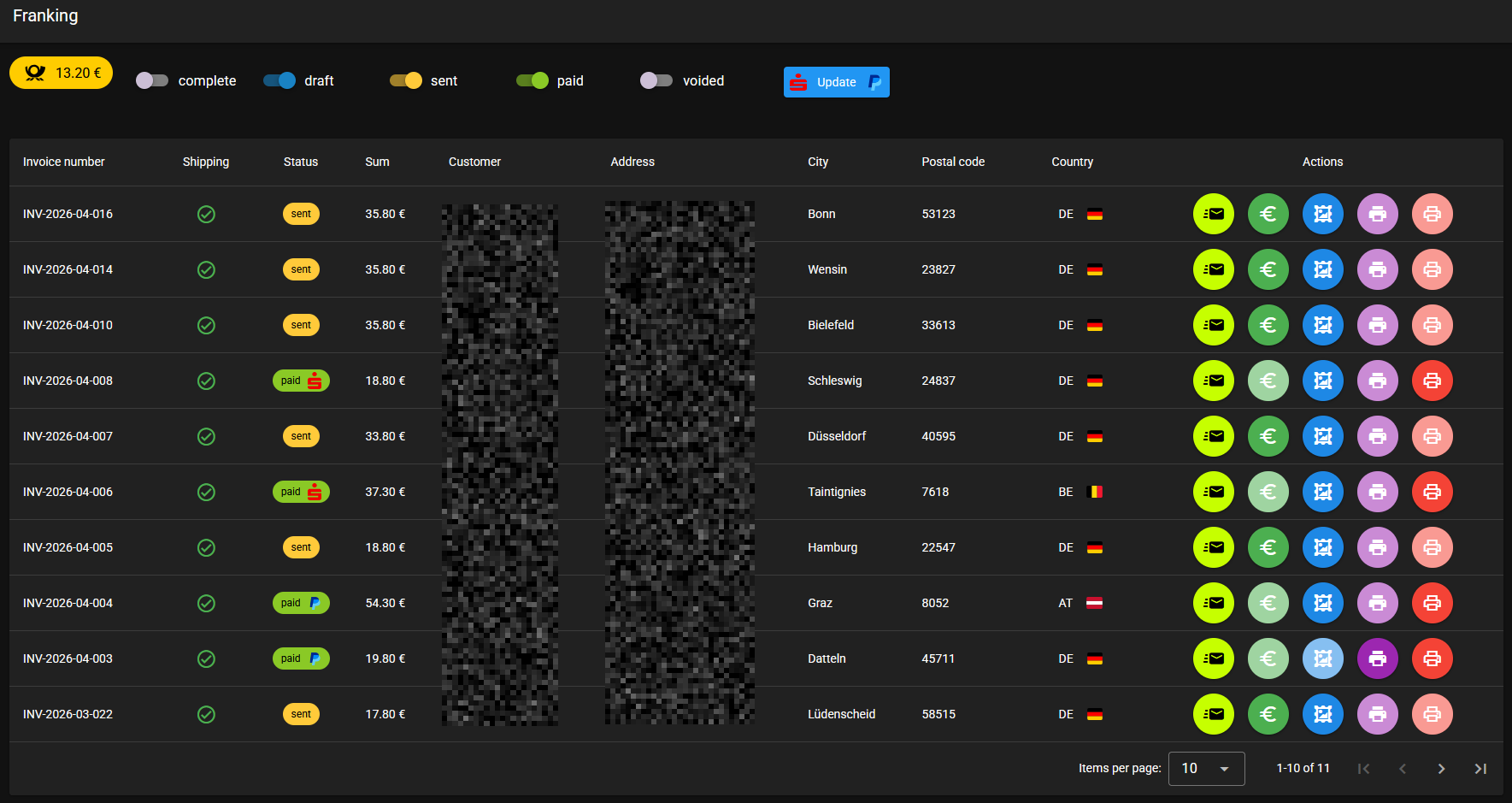
A hacky project that uses FastAPI as the backend and vuetify for the frontend. It also uses python-inema for purchasing the Internetmarken and brother_ql for printing the labels on the Brother QL 710W printer.
To make things even more convenient, I integrated the PayPal API and python-fints to fetch received payments, compare them to not yet paid invoices and mark them as paid if a match is found. The FinTS part was a bit challenging as banking regulations require each application that wants to interface with a bank to have its own Product ID. For thsi you have to apply for such an ID with the “ Die deutsche Kreditwirtschaft ” which I did. I didn’t expect them to give me an ID as an individual, but after a couple of days, I received mine.
What franking now can do for me:
- Fetch the current Portokasse balance (thats the account from which the Internet marke is paid)
- Send invoices directly from the UI to the e-mail address in the user created in Invio
- Mark invoices as paid in Invio via its API, either automatically via PayPal and FinTS API or in case a customer didn’t write the invoice number in their transaction, manually.
- Purchase a Internetmarke for a Grossbrief national or Grossbrief international using the address data from Invio, depending on the customers country code
- Printing the Internetmarke
- Printing the invoice on paper
- Marking the Invoice as complete once I packed an order
This made the process more fun than I originally expected. I hope for more orders in the future to have an excuse to improving the system even further 😅